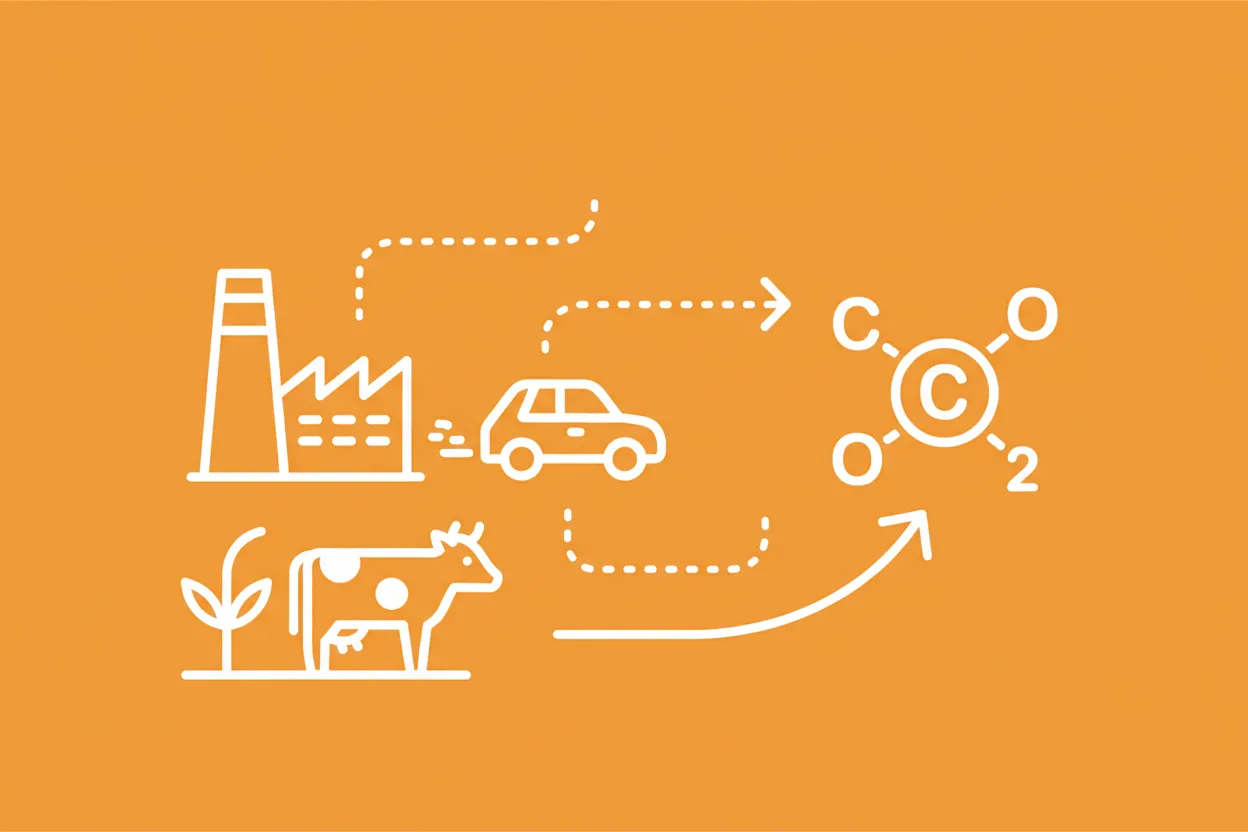
What if there was a simple way to compare the climate impact of different greenhouse gases? CO2 Equivalent (CO2e) does just that by turning all their effects into the same “language” as carbon dioxide.
Why does this matter for sustainability and circular economy efforts? When companies and governments see emissions as one clear number, they can better track progress and create stronger waste and recycling policies. Want to know how your daily choices add up in CO2e?
Definition: CO2 Equivalent (CO2e)
CO2 Equivalent (CO2e) measures the combined impact of all greenhouse gases on climate change by converting their effects into the amount of carbon dioxide (CO2) that would cause the same warming over 100 years. This helps compare and understand total emissions from different sources in one clear number.
CO2e converts the impact of various greenhouse gases into the amount of CO2 that causes the same warming. It measures their combined effect on climate change in a single number.
For example, if a factory releases CO2, methane, and nitrous oxide, CO2e adds their impacts together as if they were all CO2. This lets companies and governments see the total climate effect and find ways to reduce it more easily.
How carbon dioxide equivalent helps measure greenhouse gas impact
Have you wondered how different greenhouse gases are compared fairly? Since gases like methane and nitrous oxide trap heat differently, a common measuring stick is needed. Carbon dioxide equivalent (CO₂e) acts as that shared unit.
This system converts various greenhouse gases into the amount of CO₂ that would cause the same warming effect over 100 years. Global Warming Potential (GWP) scores, set by climate scientists, guide this conversion. For example, methane’s GWP of 25 means it’s 25 times stronger than CO₂ in warming power.
Using CO₂e makes it easier for businesses and governments to track their emissions. It supports clearer climate policies and helps set meaningful reduction goals. Comparing apples to apples becomes possible when emissions are expressed in CO₂e.
By simplifying complex emissions into one number, CO₂e strengthens our ability to fight climate change. It’s a key tool for making smarter, more effective environmental choices.
6 examples on measuring greenhouse gas impact
Here are some common ways we express the impact of different gases in terms of their climate effect:
- Methane: This gas has a much higher warming potential than carbon dioxide. It’s released during waste decomposition and livestock digestion.
- Nitrous oxide: Found in fertilizers and vehicle emissions, this gas traps heat more efficiently than CO2. It contributes significantly to agriculture’s climate footprint.
- Fluorinated gases: Used in refrigeration and air conditioning, these synthetic gases have a very high warming effect. They often linger in the atmosphere for a long time.
- Carbon dioxide: The most common greenhouse gas, mainly from burning fossil fuels like coal and gasoline. It’s the baseline for comparing other gases.
- Landfill gas: A mix mostly of methane and CO2, produced when organic waste breaks down without oxygen. Managing this gas reduces waste’s climate impact.
- Black carbon: Tiny particles from burning fossil fuels and biomass, it absorbs sunlight and heats the atmosphere. Though short-lived, it has a strong warming influence.
Some gases have a much stronger effect per unit than others, making it important to consider their full impact, not just the amount released. This helps industries and governments set better priorities for reducing emissions.
Terms related to greenhouse gas measurements
Greenhouse gases trap heat in the atmosphere, contributing to climate change and affecting our planet's health.
- Greenhouse Gas Emissions: The release of gases like methane and carbon dioxide that warm the Earth.
- Carbon Footprint: The total amount of greenhouse gases produced by an individual, product, or organization.
- Global Warming Potential: A way to compare how much heat different gases trap in the atmosphere over time.
- Climate Change: Long-term shifts in temperature and weather patterns caused by human activities and natural factors.
- Life Cycle Assessment: A method to measure the environmental impact of a product from creation to disposal.
- Carbon Accounting: Tracking and measuring the amount of carbon emissions released or saved by activities.
- Emission Trading Systems: Market-based programs where companies buy and sell allowances to emit greenhouse gases.
Frequently asked questions on CO2 equivalent (CO2e)
CO2e helps measure the impact of different greenhouse gases in one simple number.
What is greenhouse gas emissions?
Greenhouse gas emissions are gases like carbon dioxide and methane released by activities such as burning fossil fuels. They trap heat in the atmosphere, contributing to climate change. CO2e sums up these gases based on their warming effect.
How does carbon footprint relate to CO2e?
Your carbon footprint is the total CO2e from your daily activities, like driving or using electricity. It shows the impact your lifestyle has on the climate, helping you find ways to reduce emissions.
What does global warming potential mean?
Global warming potential (GWP) compares how much heat different gases trap over time. CO2 has a GWP of 1, so other gases are converted into CO2e using their GWP to show their equal impact.
How is life cycle assessment connected to CO2e?
Life cycle assessment (LCA) looks at the total environmental impact of a product, including CO2e emissions at every stage—from making it to disposal. This helps businesses design more sustainable products.
Why is carbon accounting important?
Carbon accounting tracks CO2e emissions for companies or products. It helps identify where emissions come from and supports strategies to lower them, making sustainability goals clearer and achievable.
What role do emission trading systems play?
Emission trading systems let companies buy or sell allowances for CO2e emissions. This market approach encourages reducing emissions cost-effectively and supports overall climate targets.
